
Showing posts with label Welding technology. Show all posts
Showing posts with label Welding technology. Show all posts
Wednesday, 15 August 2012
 Filler metal:

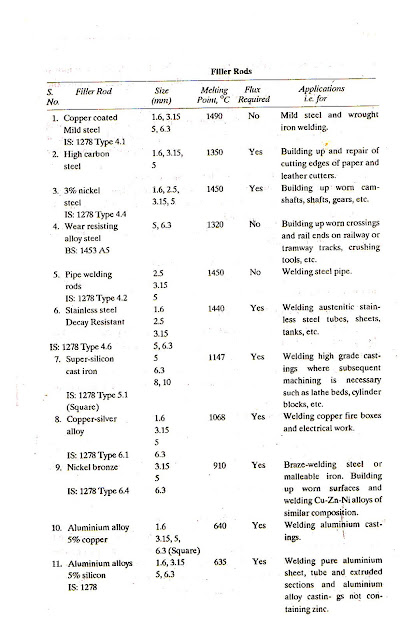
It is the material that is added to the weld pool to assist in filling the gap or groove. Filler metal forms an integral part of the weld. Filler metal is usually available in rod form. These rods are called filler rods. Filler rods have the same or nearly the same chemical composition as the base metal. Welding filler rods are available in a variety of composition and sizes. Some of them are given in the table below:

Flux:
During welding if the metal is heated or melted in air, oxygen from the air combines with metal to form oxides which result in poor quality, low strength weld or in some cases may even make welding impossible. In order to avoid this difficulty, a flux is employed during welding. A flux is a material used to prevent, dissolve or facilitate removal of oxides and other undesirable substances. A flux prevents the oxidation of molten metal. Flux may be used either by applying it directly on the surface of the base metal to be welded or by dipping the heated end of the filler rod in it. The flux sticks to the filler rod end. No flux is used in the gas welding of steel.
- Flux for welding cast iron: Fluxes for gray iron rods usually composed of borates or boric acid, soda ash and small amounts of sodium chloride,etc.
- Flux for welding stainless steel: Flux may contain compounds such as borax, boric acid, fluorspar, etc.
- Flux for welding aluminium and its alloys: The flux may be applied on the base metal by brushing and on the filler rod end by dipping the same into the flux paste just before welding. Fluxes employed for welding aluminium and its alloys are compounds of lithium, sodium and potassium and are obtainable in either paste or powder form.
- Flux for welding copper and its alloys: Flux is not necessary for gas welding of pure copper, however for copper alloys, borax based fluxes may be used.
- Flux for welding magnesium and its alloys: Flux must be applied to all edges to be welded and to the welding rod when welding magnesium and its alloys. A flux may contain sodium chloride, potassium fluoride, magnesium chloride, barium fluoride.
- Fluxes for welding nickel and its alloys: Gas welding of pure nickel requires no flux. However alloys of nickel such as inconel and monel require a flux to further clean the base metal and to break up the oxides that are formed as a result of the alloying agents. Flux for inconel may contain Ca(OH)2 , boric anhydride.
Wednesday, 15 August 2012 0
Introduction to Gas Welding:
Gas welding is a fusion welding process. It joins metals using the heat of combustion of oxygen/air and fuel gas that is acetylene, hydrogen or butane. The intense heat or flame thus produced melts and fuses together the edges of the parts to be welded with the addition of a filler metal.
Oxy-acetylene welding:
When acetylene is mixed with oxygen in correct proportions in the welding torch and ignited, the flame resulting at the tip of the torch is sufficiently hot to melt and join the parent metal. The oxy-acetylene flame reaches a temperature of about 3200 C and thus can melt all commercial metals which, during welding, actually flow together to form a complete bond. A filler metal rod is generally added to the molten metal pool to build up the seam slightly for greater strength. The maximum temperature of the oxy-acetylene flame is 3100 to 3200 C and the center of the heat concentration is just off the extreme tip of the white cone. Combustion of gas mixture is recognized as taking place in two main stages:

- Stage 1: Oxygen and acetylene in equal proportions by volume burn in the inner white cone. The oxygen combines with carbon of the acetylene and forms carbon monoxide and hydrogen is liberated.
- Stage 2: Upon passing into the outer envelope of the flame two more reactions take place as combustion is completed. The carbon monoxide uses the oxygen supplied from the air surrounding the flame and as a result of burning forms carbon dioxide. The hydrogen also burns with oxygen from atmosphere and forms water vapour. It can be seen that about 2/5 of oxygen necessary for the complete combustion of acetylene is got from the cylinder whereas the rest comes from the surrounding air atmosphere because of the need for supplemental oxygen from the atmosphere, the acetylene oxygen flame cannot be used inside of pipes or structures subjected to oxygen depletion from gas welding. By varying the relative amounts of acetylene and oxygen in the gas mixture in the torch, a welder can produce different flame atmospheres and temperatures as he requires.
Flame adjustment:
- To start with, when the oxy-acetylene gas welding torch is ignited, it gives an acetylene flame in which enough oxygen is drawn in from the atmosphere to burn acetylene partially. From acetylene flame, abundance of free carbon is released into the air. An acetylene flame may be used to apply carbon to mold faces in the foundry, because the carbon acts as an insulator between the molten metal and the mold face.
- As the oxygen valve in the torch is progressively opened, the flame becomes generally luminous. Then the luminous portion contracts towards the welding tip, forming a distinct bright zone within a blue outer envelope. This is a carborising flame and has large excess of acetylene.
- With further increase of oxygen content, the bright zone of the flame contracts farther and is seen to consist of two parts: a brighter inner cone and a pale green feather trailing off its end into the blue envelope, this is reducing flame.
- If at this stage oxygen flow is increased gradually, a certain point will reach where one will notice a distinct change in the sound of the flame and a well-defined white cone will appear near the tip, surrounded by a bluish envelope that is faintly luminous. This is neutral flame. There is an approximate one-to-one mixture of acetylene and oxygen to result a neutral flame.
- Further increase of oxygen content into the mixture will give rise to an oxidising flame.
To extinguish the flame and stop welding:
- When the welding or cutting operation is finished, close the torch acetylene valve first and then turn off the torch oxygen valve.
- Close the oxygen cylinder valve
- Release the pressure in the hose and regulator by opening the oxygen control valve on the torch.
- Release the pressure in the oxygen regulator diaphragm by turning the regulator to the minimum pressure position.
- Close the oxygen control valve on the torch.
- Repeat the same procedure for purging acetylene.
The chosen welding processes of practical significance in underwater welding are:
- Manual shielded meal arc welding, that is extensively used as a wet technique but is also suitable for habitate welding.
- TIG welding.
- MIG welding.
TIG and MIG welding processed have also been used to a limited extend for wet welding as well as more commonly in local enclosed gas shrouds.
1. Shielded metal arc welding:
Manual shielded metal arc welding is an economical process for underwater welding. This process can be carried out in all positions with the same success as welding in air. The DC welding equipment used for underwater welding must have a capacity of at least 300 Amps for each welder. All electrical leads, lighting gear, electrode holder, gloves, etc must be fully insulated and in good condition. Ferritic electrodes with a coated based on iron oxide should be used as they resits cracking, Positive polarity of work is preferred. This means that 65% to 75% of the heat is in the metal being welded. The weld pool is easier to handle and has enough fluidity to fill in undercut to a large extend. Electrode having positive polarity may have to be used for overhead butt-welding or welding cracks in the vertical and overhead positions. Current setting for underwater welding are normally higher than for welding air because there is a loss of heat by conduction through water and the control of these settings must be accurate to ensure consistent work.
2. TIG welding:
TIG welding has got the advantage that it gives a stable arc and less porous welds. TIG welding has been widely used, particularly for root runs. Although this process is relatively slow, it is very flexible and can accommodate variations in fit up and produce high quality penetration beads. TIG welding is preferred to MIG welding in dry welding as filler wire is manually controlled.
In TIG welding, as the depth (ie pressure) increases:
- The arc becomes constricted and the voltage increases for a given arc length.
- Tungsten tip starts getting eroded and this phenomenon influences weld bead width, and penetration. The erosion of the tip gives rise to arc instability when TIG welding is carried out at high pressure.
- Arc welding becomes more difficult.
TIG welding becomes restricted as the operating depth is increased.
3. MIG welding:
Because of the high cost of diving operations, it is highly desirable to complete welds in the shortest possible time. This has directed attention to the use of semi-automatic processes using solid wires or flux code wires. Wires containing oxidising and reducing elements give good results even without shielding. MIG welding is faster and less expensive that TIG welding. Arc heat increases with the depth of water so filler metal melts fast CO2 or Argon is used as shielding gas. The shielding gas gets denser and may require flow rates upto 10 times the surface rates. MIG dry welding is preferred to MIG wet welding for better results.
International interests to develop and utilize oceans which cover 70% of the earth and its resources such as development of offshore gas and oil field, fisheries multiplication, large offshore construction and mineral resources, mining in the sea bottom,etc; have let to the development of underwater welding. Underwater welding has been used for temporary repair work caused by ships collisions, unexpected accidents, corrosion and other maintenance works.
Types of Underwater Welding:
Following are the types of underwater welding:
1. Wet welding
2. Dry welding :
1. Hyperbaric welding
2. Cavity welding
Subscribe to:
Posts (Atom)


